
Reviewing my notes from Emma Stratton’s talk at INBOUND25, which took place in September in San Francisco, I realized that the content about messaging for AI products was too good to keep to myself. And the most curious thing is that, even though it’s aimed at technology companies, it makes perfect sense for any sector that needs to communicate value clearly.
Today, most companies try to sell their AI solutions as something innovative, revolutionary, disruptive. But, amidst this enthusiasm, two traps are repeated: either they sound the same as everyone else, or they confuse the customer with jargon and vague promises. The result is predictable — instead of generating trust, the communication increases distrust.
Neuroscience explains the reason well. Our brain is lazy by nature: it avoids spending energy decoding complex messages. Kahneman (one of the founding fathers of Behavioral Economics and author of the book Thinking, Fast and Slow) called this cognitive fluency: the easier an idea is to understand, the more reliable and true it seems to us.
However, in their eagerness to appear sophisticated, many companies end up creating messages that require too much effort to understand. And when this happens, the customer’s brain triggers a red flag: “this must be risky, better not to proceed.”
Emma Stratton’s Framework
Emma brought a simple but powerful framework -> adjust the level of the message to the maturity of the audience, use concrete language and avoid jargon, and highlight the unique value clearly, directly connecting the product to the real impact it generates. It seems obvious, but it’s not. Just look at how many websites and presentations you’ve seen that promise to “grow businesses with cutting-edge technology” without actually explaining how that translates into the daily lives of those who buy it.
- Adjust the altitude of the message according to how much your audience understands about AI (or any technology).
- Use concrete language, avoiding jargon that serves the ego of the speaker more than the clarity of the listener.
- Highlight the unique value, connecting the product to the real impact it generates in the customer’s daily life.
This reasoning echoes the idea of contextual relevance from behavioral economics: the closer the message is to the problem experienced by the customer, the more it activates attention and motivation.
Practical example (recruitment company with AI)
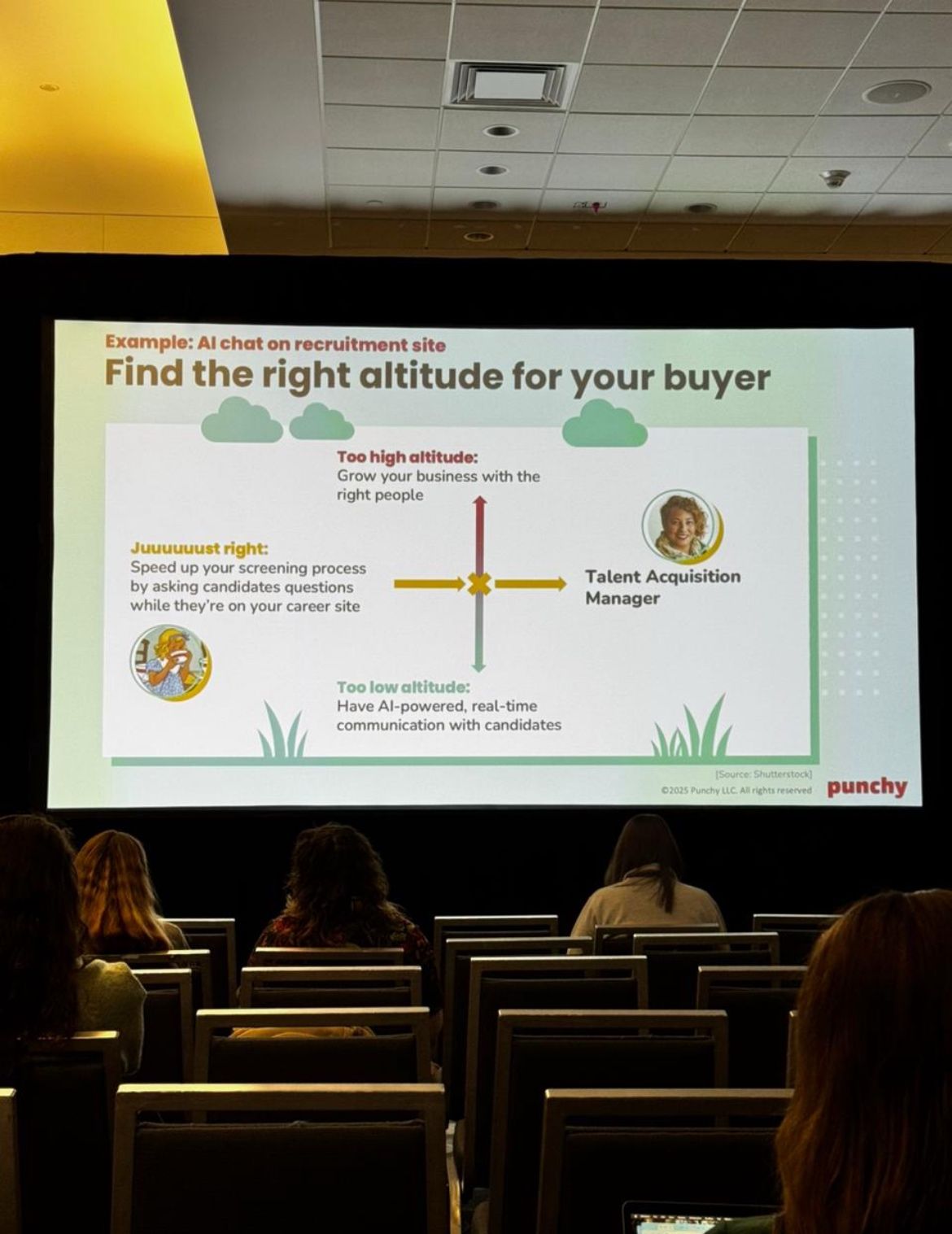
Imagine an AI chatbot on a job site. It can be communicated in several ways:
- Very high altitude: “Grow your business with the right people.” (too vague, doesn’t connect)
- Ideal altitude: “Accelerate the screening process by asking candidates questions while they are on your careers site.” (simple, direct, shows real impact)
- Very low altitude: “Have real-time communication with candidates using AI.” (too technical, generates noise)
And the most interesting thing is that this reasoning doesn’t only apply to technology. A law firm can fall into the same trap by saying it “solves complex disputes,” when it could be much clearer by stating that it “reduces labor litigation time by 30% using legal intelligence.” A vaccination clinic too: instead of talking about “taking care of the whole family’s health,” it could say “avoid six days of absence due to the flu with a single annual dose.”
Applied Neuroscience: Why it Works
Clear messages, placed at the right altitude, reduce decision anxiety. The human brain is averse to uncertainty: the more concrete and tangible the value, the faster we activate the reward system (dopamine) that brings us closer to the choice.
In addition, clarity creates emotional differentiation. In a sea of companies that sound the same, those who can translate technology into impact gain not only attention but also trust.
Notice the difference. When the message is vague or excessively technical, it leaves room for doubt, and doubt is synonymous with risk. But when it is clear, specific, and placed in the right context, the client’s brain relaxes. The anxiety of the decision decreases and the reward system is activated — it’s as if the mind were saying: “this makes sense, it’s useful for me, I can trust it”.
In the end, clarity is not a stylistic detail, it’s a competitive advantage. In a market where everyone talks about AI, those who can translate technology into human value come out ahead.
Perhaps true innovation lies not in creating increasingly grandiose messages, but in simplifying the complex in a way that anyone can understand. Because ultimately, what matters is not the technology itself, but the trust it can generate at the moment of choice.